
Solar Fence IoT Monitoring System
Know the moment your electric fence stops protecting you.
Wireless sensing nodes watch every stretch of the perimeter and report faults to your phone — no daily patrols, no guesswork.
Also available as a dark-theme brochure.
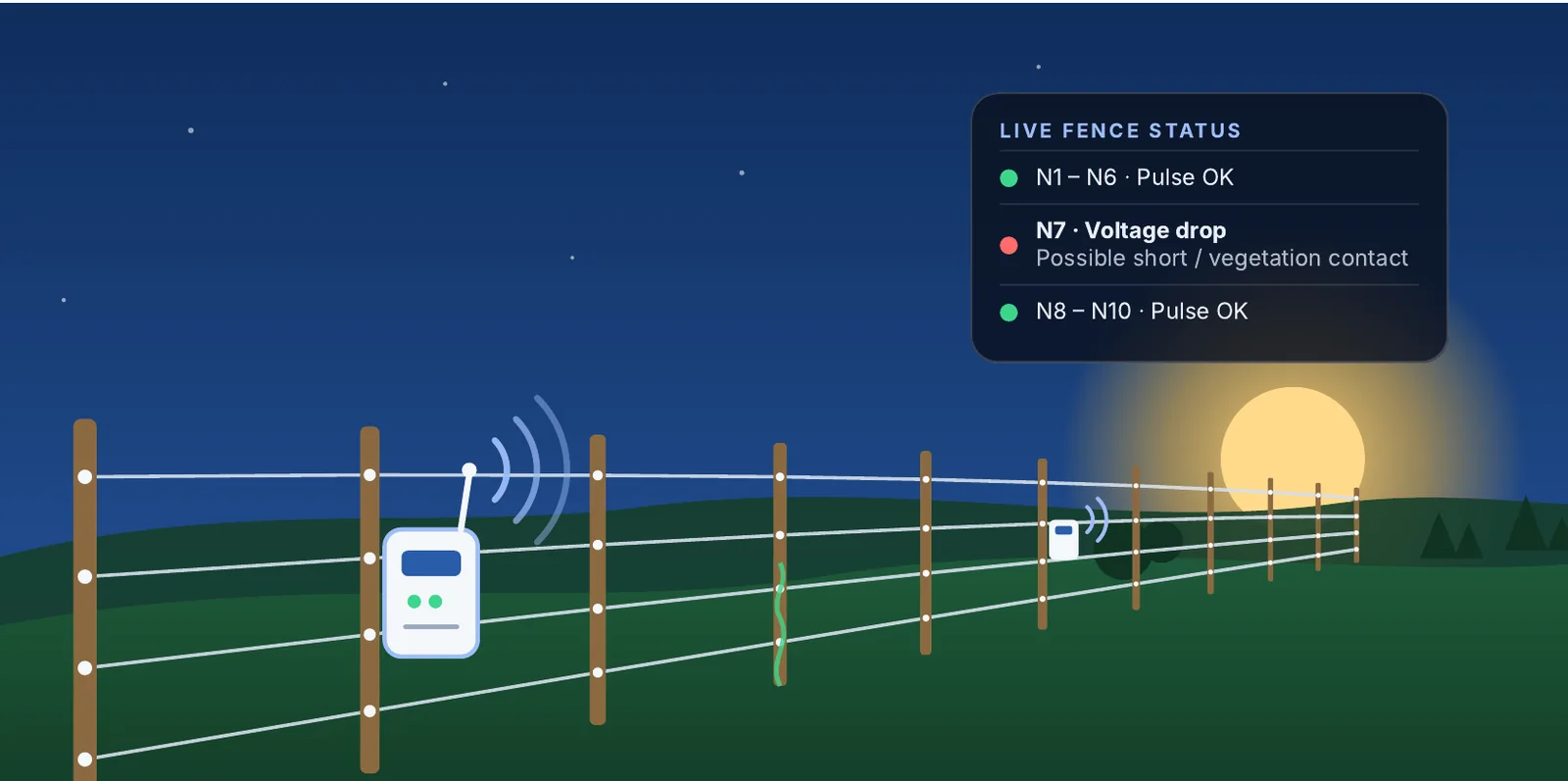
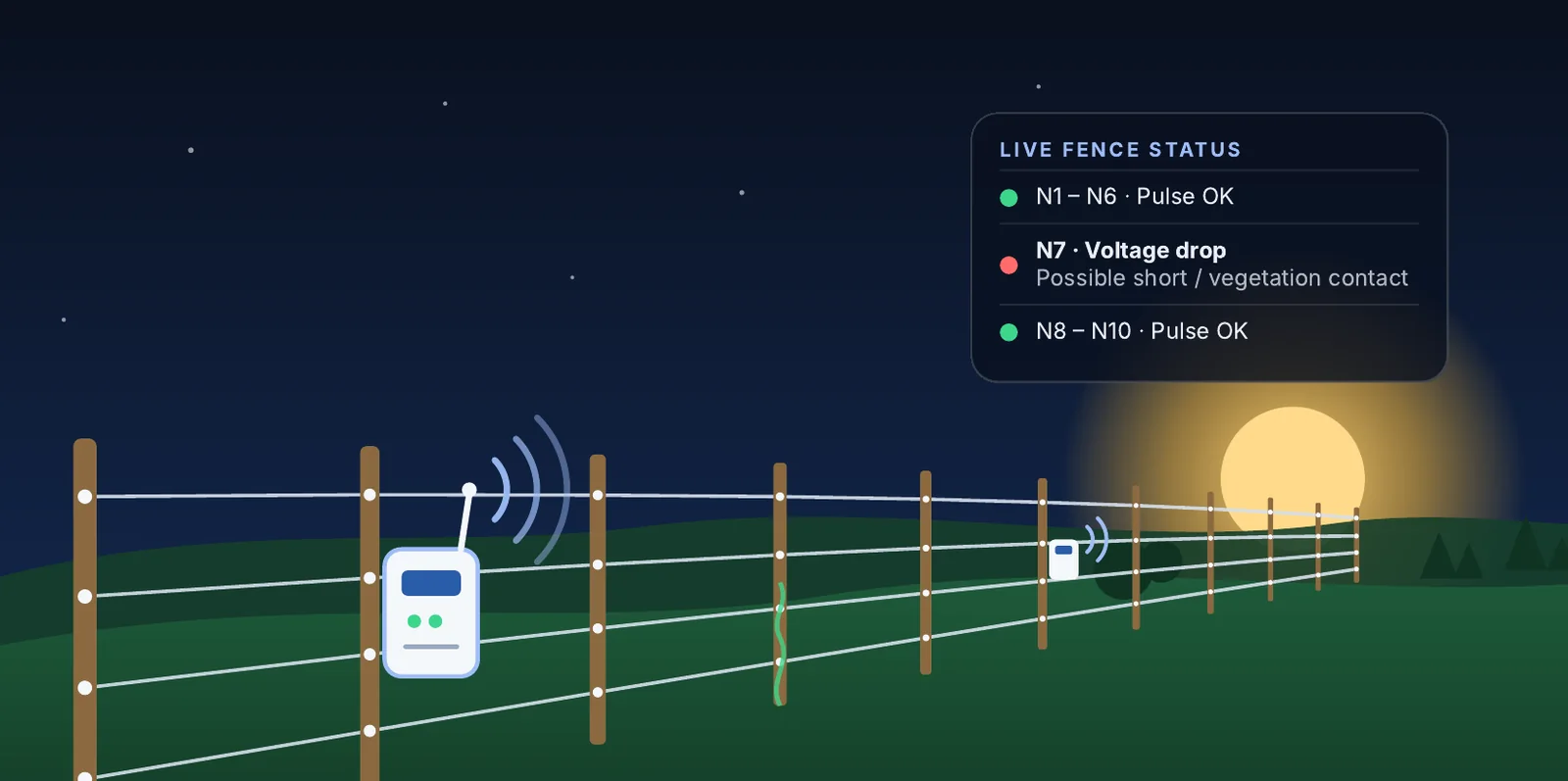
Solar fences fail silently. Intruders notice before you do.
Fallen trees & branches
Short the wires or snap strands after storms.
Creepers & vegetation
Grow along poles and wires, leaking current to earth.
Animals trapped
Entangled animals stretch, short or break the line.
Wire breaks & tampering
Open circuits leave whole sections unprotected.
A fence only deters while it is energised end to end
- The fence
- Remote industries and farmlands rely on solar electric fencing to keep out intruders, unwanted visitors and wild animals. It delivers very short, high-voltage pulses — a sharp, deterrent shock designed not to cause lasting harm.
- The risk
- A single fault can drag down the voltage along a long section — and nothing tells you it has happened.
- The old way
- Keeping a long perimeter healthy has meant walking it on a daily or regular basis. On a 10 km boundary that is slow, costly, and still leaves hours of exposure between inspections.
Continuous, wireless health monitoring for the entire fence
Sensing nodes installed along the fence watch the high-voltage pulses, detect anomalies and report them wirelessly. An IoT gateway carries every node's status to the cloud over 4G, so your operations team or the farmer can see which segment has a problem and go straight to it.
Low fence voltage
Pulse amplitude falling below a healthy level along a segment.
Short / earth leakage
Vegetation, fallen trees or trapped animals loading the line.
Open circuit
Broken or cut wire — pulses no longer reach the segment.
Energiser off
No pulses anywhere: energiser, battery or solar supply issue.
Node offline
A sensing node stops reporting — flagged for attention.
Fault location
Alert names the node, narrowing the search to one segment.
Manual patrols vs IoT monitoring
Manual patrols
- Daily walks along kilometres of fence
- Faults found hours or days late
- Whole perimeter searched to find one problem
- No record of when or how often faults occur
With IoT monitoring
- Fence health visible around the clock
- Alerts as soon as an anomaly is detected
- Team goes straight to the affected segment
- Fault history to plan vegetation clearing
From fence wire to your phone — in four steps
Sensing nodes are placed along the fence — for example every 500 to 750 m on a 10 km perimeter. Every node communicates directly with one IoT gateway over RF wireless. The gateway uses 4G to reach Creatronix Cloud, where status and alerts can be viewed on a desktop, laptop or mobile.
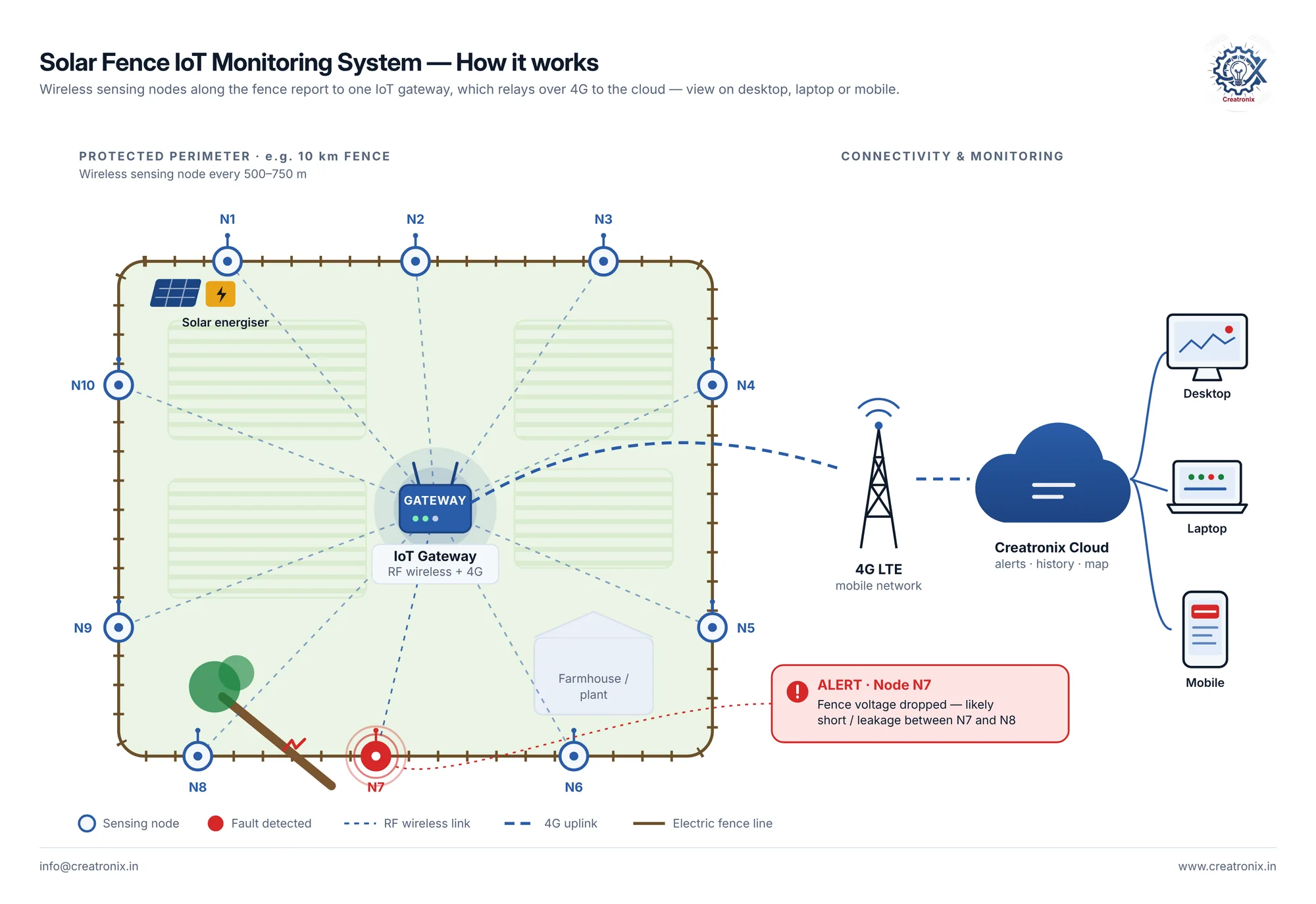
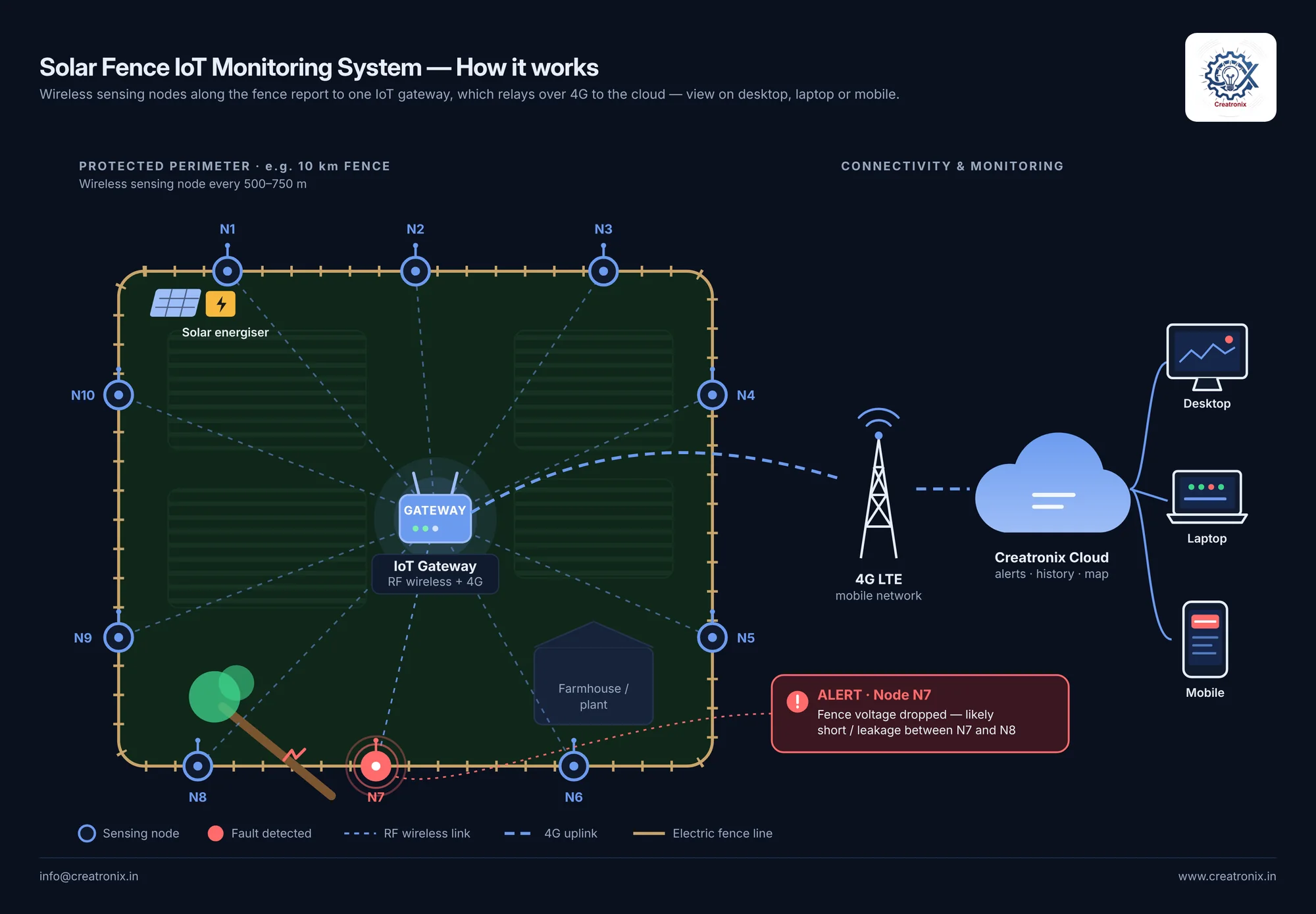
- SenseEach node monitors the fence pulses on its segment and looks for anomalies.
- TransmitNodes report wirelessly over RF straight to the IoT gateway — no field cabling.
- ConnectThe gateway relays all node data over 4G LTE to Creatronix Cloud.
- ActTeams see the faulty segment on screen and dispatch someone to fix it.
Every segment at a glance
Fence segments
Recent events
- N7 · Fence voltage low — check N7–N8
- N3 · Voltage restored after clearing
- All · Energiser pulses normal
Three parts. One complete view of your perimeter.
- Monitors fence pulses on its segment
- Detects low voltage, shorts, leakage and open circuits
- RF wireless link direct to the gateway
- Weather-resistant outdoor enclosure
- Clamp-on install; no trenching
- Receives data from all sensing nodes over RF
- Built-in 4G LTE uplink to the cloud
- Manages the entire wireless fence network
- Reports node health and connectivity
- Ideal for sites without wired internet
- Live status of every fence segment
- Instant alerts with node location
- Fault and event history
- Multi-user access for owners and ops teams
- View on desktop, laptop or mobile
Built for long, remote perimeters
Farmlands & orchards
Plantations & estates
Remote industrial sites
Solar & utility plants
Warehouses & yards
Wildlife-border villages
10 km perimeter
- Node spacing
- Every 500 – 750 m
- Sensing nodes
- Approx. 14 – 20
- IoT gateway
- 1 per site
- Node → gateway
- RF wireless, direct
- Gateway → cloud
- 4G LTE
- Access
- Desktop, laptop, mobile
Indicative. Node count and placement are finalised after a site survey.
Frequently asked questions
What faults does the system detect?
Low fence voltage, shorts and earth leakage, open circuits from broken or cut wire, an energiser that is off, and sensing nodes that stop reporting.
Does it need cabling along the fence?
No. Sensing nodes report to the IoT gateway over RF wireless, and the gateway uses 4G to reach the cloud.
How many sensing nodes are needed?
Typically one node every 500 to 750 m, so a 10 km perimeter needs about 14 to 20 nodes. The final count is set after a site survey.
Where do I see the alerts?
On a desktop, laptop or mobile. Each alert names the node, so your team goes straight to the affected segment.
Stop walking the fence. Start watching it.
Request a site assessment or product demonstration.